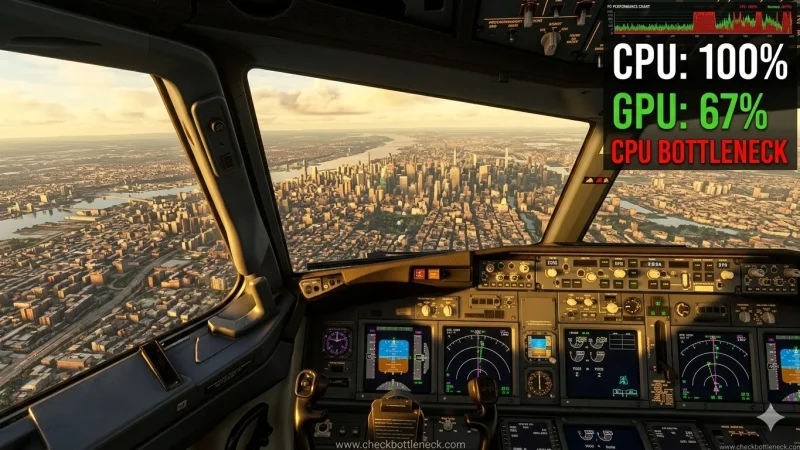
The Microsoft Flight Simulator bottleneck is unlike any other game on PC — it affects every single system, including rigs with the fastest CPUs available in 2026. No current consumer processor can fully eliminate a CPU bottleneck in Microsoft Flight Simulator. This is not a flaw in your system. It is a reflection of how extraordinarily demanding this simulation is. This page explains why, what you can realistically do about it, and what hardware delivers the best experience. Check your specific system with our free bottleneck calculator.
Why Microsoft Flight Simulator Bottlenecks Every CPU
Microsoft Flight Simulator 2024 simultaneously models global weather pulled from real-world meteorological data, live air traffic from thousands of actual aircraft, terrain streaming for the entire planet using Bing Maps satellite data, individual aircraft systems with realistic physics and aerodynamics, and environmental rendering across thousands of square kilometers of visible scenery. The main simulation thread is largely single-threaded — no matter how many CPU cores you have, the primary game loop runs primarily on one or two threads. This is why a 32-core Threadripper does not dramatically outperform a high-clocked 8-core chip in this game.
Minimum CPU for Microsoft Flight Simulator
Intel Core i7-12700K or AMD Ryzen 7 7700X. Even at this level you will experience noticeable Microsoft Flight Simulator bottleneck in demanding scenarios such as major international airports, large cities at low altitude, and severe weather conditions.
Recommended CPU for Microsoft Flight Simulator
Intel Core Ultra 9 285K or AMD Ryzen 9 9950X. Intel’s architecture tends to maintain a single-core clock speed advantage that is specifically beneficial in Microsoft Flight Simulator’s main simulation thread. According to Digital Foundry’s MSFS hardware analysis, single-core performance is the most important CPU metric for this title.
Minimum GPU for Microsoft Flight Simulator
RTX 3080 or RX 6800 XT for 1080p at High settings.
Recommended GPU for Microsoft Flight Simulator
RTX 5080 or RX 9070 XT for 4K Ultra settings with full detail draw distances.
RAM — This Game Needs More Than You Think
Use 32GB as the absolute minimum. 64GB is strongly recommended for users running payware aircraft, complex addon scenery, or live weather and traffic simultaneously. This is one of very few consumer games where 64GB RAM produces a measurable improvement over 32GB. Fast DDR5-6000 or DDR4-3600 in dual-channel mode also matters more in Microsoft Flight Simulator than in almost any other game because terrain streaming throughput is heavily RAM bandwidth-dependent. See our guide on does RAM affect bottleneck for the technical explanation.
Storage Is Not Optional — It Is Critical
A fast NVMe Gen4 SSD is not a luxury in Microsoft Flight Simulator — it is a requirement. The game streams terrain, buildings, and scenery data in real time as you fly. Over an HDD, this produces visible terrain pop-in, loading stutters at every new area, and frame time spikes during fast low-altitude flight. An NVMe Gen4 SSD loads the same assets in a fraction of the time, producing smooth continuous streaming. No GPU upgrade can fix a storage bottleneck in this game.
Free Fixes for the Microsoft Flight Simulator Bottleneck
Increase your terrain LOD and object draw distance settings — these push more work to the GPU rather than the CPU, reducing the Microsoft Flight Simulator bottleneck slightly.
Fly at higher altitudes where terrain streaming demands are lower and NPC density is minimal. The CPU bottleneck is most severe at low altitude over dense cities and major airports.
Enable XMP or EXPO in BIOS and confirm dual-channel RAM. Even a small memory bandwidth improvement has a measurable impact in this title.
Disable live AI traffic if you are severely bottlenecked. AI traffic is one of the largest single contributors to the Microsoft Flight Simulator CPU bottleneck.
For more tips on managing CPU limitations, read our guide on what is a CPU bottleneck in gaming and CPU bottleneck symptoms. For hardware pairing analysis, check the RTX 5090 i9-14900K bottleneck page.