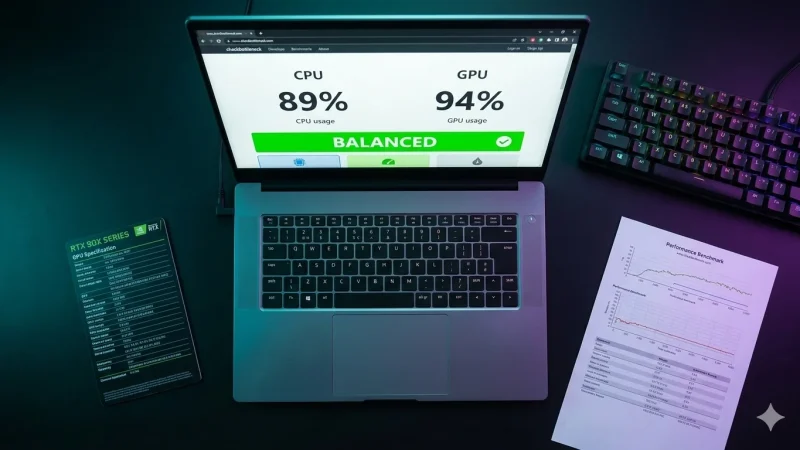
The laptop bottleneck calculator works differently from a desktop tool — because laptop bottlenecks work differently from desktop bottlenecks. In a desktop PC, your CPU and GPU operate independently with separate power budgets. In a laptop, they share a single power envelope of typically 75W to 150W, creating dynamic bottlenecks that shift depending on which component hits its power limit first. Our free bottleneck calculator covers all major laptop CPUs and GPUs so you can check your mobile configuration in under 30 seconds.
Why a Laptop Bottleneck Calculator Is Different From Desktop
When you pair a desktop RTX 4070 with any modern CPU, the GPU always delivers its full rated performance regardless. When you pair an RTX 4070 Laptop GPU with a CPU in a laptop, both components are competing for the same shared power budget. During demanding gaming sessions, the laptop’s power delivery system must choose how to split watts between the CPU and GPU — and neither component gets its full rated performance. This is why a laptop bottleneck calculator must account for TDP tier and thermal envelope, not just raw benchmark scores.
The Hidden Variable: GPU Wattage Tier
The biggest variable in any laptop bottleneck calculator result is the GPU wattage tier. An RTX 4070 Laptop at 80W and an RTX 4070 Laptop at 140W share the same product name but deliver performance separated by nearly 30%. Always confirm your laptop’s specific GPU wattage before comparing it to benchmarks or other systems.
Laptop Pairing Recommendations
Budget Gaming Laptop CPU: Intel Core i5-13500H GPU: NVIDIA RTX 4060 Laptop at 100W or higher Expected Laptop Bottleneck: Under 14% at 1080p Best Resolution: 1080p at 144Hz
Mid-Range Gaming Laptop CPU: Intel Core i7-13700H or AMD Ryzen 7 7745HX GPU: NVIDIA RTX 4070 Laptop at 125W Expected Laptop Bottleneck: Under 10% at 1080p Best Resolution: 1080p at 144Hz to 240Hz
High-End Gaming Laptop CPU: Intel Core i9-13980HX or AMD Ryzen 9 7945HX GPU: NVIDIA RTX 4080 Laptop at 150W Expected Laptop Bottleneck: Under 7% at all resolutions Best Resolution: 1440p gaming and creative work
Desktop Replacement CPU: Intel Core Ultra 9 185H or AMD Ryzen 9 7945HX GPU: NVIDIA RTX 4090 Laptop at 175W Expected Laptop Bottleneck: Under 8% Best Resolution: 4K creative work and gaming
Free Performance Fixes for Laptop Users
Enable the MUX switch if your laptop has one. This bypasses the integrated graphics routing and connects the GPU directly to the display, eliminating a significant source of latency and CPU overhead. Laptops with a MUX switch typically see 10 to 20% higher frame rates simply by enabling it in the manufacturer software. According to Notebookcheck’s MUX switch benchmark analysis, MUX switch enablement produces one of the largest free performance improvements available to laptop gamers.
Always play plugged into AC power. Battery mode enforces strict power limits on both the CPU and GPU simultaneously. A gaming laptop on battery can deliver as little as 50% of its plugged-in performance — removing what appears to be a hardware bottleneck that is actually just a power management bottleneck.
Set your laptop to Performance or Turbo power mode using your manufacturer’s software. ASUS Armoury Crate, MSI Center, Lenovo Vantage, Razer Synapse, and similar applications include performance profiles that remove power restrictions.
Keep vents clear and use a laptop cooling pad. Thermal throttling is one of the most common laptop bottleneck sources. When the CPU or GPU exceeds its thermal limit, the system reduces clock speeds automatically. A cooling pad can lower temperatures by 5 to 15 degrees Celsius, preventing throttling entirely.
Enable XMP or EXPO if your laptop BIOS supports it. Some gaming laptops ship with RAM running at 2133MHz by default even if the hardware supports 4800MHz or higher. Read our full guide on does RAM affect bottleneck to understand how much this matters.
Common Laptop Bottleneck Symptoms
GPU usage consistently below 85% during demanding games, frame rates that do not improve when lowering GPU-heavy settings, performance that changes dramatically between plugged-in and battery modes, fans running at maximum speed with FPS still disappointing, and GPU temperature sitting at exactly 83°C — the throttle point for most NVIDIA laptop GPUs — without ever going higher. Read our full guide on CPU bottleneck symptoms for a complete diagnostic checklist.
For desktop pairing comparisons that put laptop performance in context, check the RTX 4070 Ryzen 5 5600X bottleneck and RTX 4080 Ryzen 7 7800X3D bottleneck pages. For guidance on your next upgrade decision, read should I upgrade CPU or GPU first.