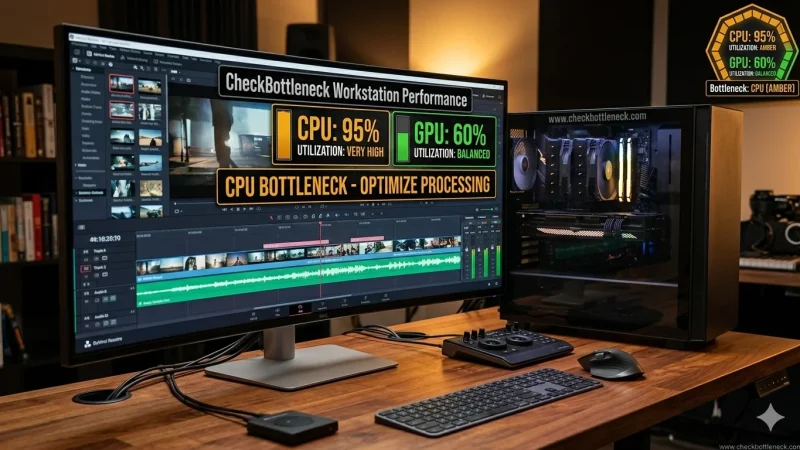
A video editing bottleneck looks completely different from a gaming bottleneck — and most PC guides treat them the same, which leads to expensive wrong upgrades. Video editing divides workload simultaneously across your CPU, GPU, RAM, and storage. A bottleneck in any single component can slow your entire editing workflow. This calculator-backed guide tells you exactly where your video editing bottleneck is coming from and what upgrade will actually fix it. Check your exact components with our free bottleneck calculator — select Video Editing as your workload profile.
Why Video Editing Bottlenecks Differ From Gaming
Gaming is primarily GPU-bound. A faster GPU delivers more frames per second. Video editing distributes work across all components simultaneously. Your CPU handles timeline playback, effects processing, color work, and export encoding. Your GPU accelerates specific effects, hardware encoding, and AI denoise features. Your RAM determines how many frames you can buffer before the system must read from disk. Your storage speed determines whether you can stream high-bitrate footage in real time.
Fixing only the GPU when the CPU is the bottleneck does nothing. This is the most common and expensive mistake video editors make.
Bottleneck by Application
Adobe Premiere Pro has a primary video editing bottleneck in the CPU. More CPU cores deliver faster timeline playback, effects rendering, and multi-track audio. The GPU accelerates specific effects and hardware encoding during export, but CPU is the primary limitation in most Premiere workflows. Minimum recommended: Core i7-13700K or Ryzen 7 7700X.
DaVinci Resolve has its primary video editing bottleneck in the GPU. It offloads color grading, noise reduction, Fusion effects, and most rendering to the GPU’s compute pipeline. VRAM capacity is critical — 12GB minimum for comfortable 4K work, 16GB or more recommended for complex grades. According to Blackmagic Design’s hardware recommendations, GPU compute performance is the most impactful factor for Resolve performance.
After Effects has its primary video editing bottleneck in the CPU and RAM. It does not benefit heavily from GPU acceleration. RAM Preview rendering speed is almost entirely CPU and RAM bandwidth dependent. 64GB RAM is the recommended minimum for complex After Effects compositions.
Hardware Tiers
1080p and Short-Form Content CPU: Ryzen 5 5600X or i5-12400F GPU: RTX 3060 or RX 6600 XT (12GB VRAM) RAM: 32GB DDR4-3200 dual-channel Storage: NVMe Gen3 SSD
4K Professional Editing CPU: Ryzen 7 7700X or i7-13700K GPU: RTX 4070 or RX 7700 XT (12GB VRAM) RAM: 64GB DDR4-3600 or DDR5-5600 dual-channel Storage: NVMe Gen4 SSD, 2TB minimum
8K and HDR Production CPU: Ryzen 9 9950X or Core Ultra 9 285K GPU: RTX 5080 or RX 9070 XT (16GB+ VRAM) RAM: 128GB DDR5-6000 dual-channel Storage: NVMe Gen5 in RAID configuration
Storage Bottleneck in Video Editing
A slow storage drive is the most overlooked video editing bottleneck. An NVMe Gen4 SSD can read 4K video files up to 20x faster than an HDD. For editors working with RAW or high-bitrate 4K footage that streams from disk during playback, an HDD causes constant dropped frames and proxy generation requirements regardless of CPU or GPU performance. Our guide on does RAM affect bottleneck also covers storage’s role in video workflows.
RAM as a Video Editing Bottleneck
Running insufficient RAM forces your editing application to use disk cache, causing the video editing bottleneck to manifest as slow scrubbing, long render times, and constant proxy rebuilding. 32GB is the absolute minimum for 4K editing. 64GB dramatically improves the experience in Premiere Pro and After Effects. See our explainer on what causes PC bottleneck for a complete breakdown.
For a full system analysis, use our free bottleneck calculator with the Video Editing workload profile and open Advanced Options to input your RAM configuration. For 3D artists who also render, check our companion page on the 3D rendering bottleneck calculator.