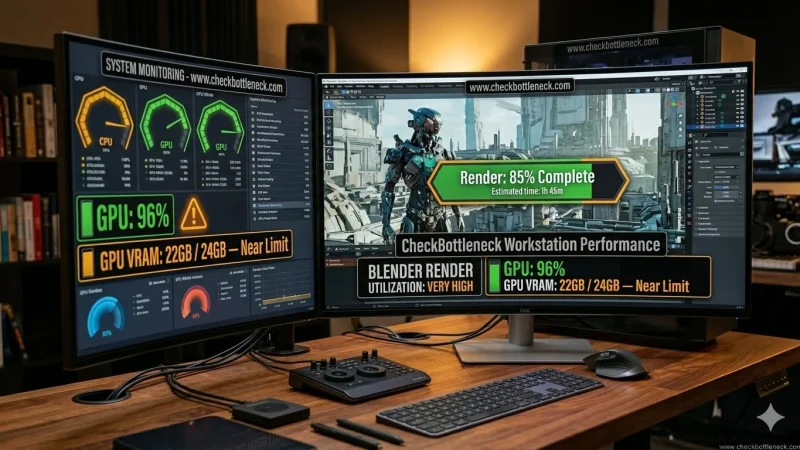
The 3D rendering bottleneck you experience depends almost entirely on which rendering engine you use — and most articles about rendering performance never make this distinction clearly. A GPU rendering engine like Octane hits a completely different bottleneck than a CPU rendering engine like Arnold. Getting the wrong upgrade because you identified the wrong bottleneck can waste thousands of dollars. This guide tells you exactly which component limits your specific rendering workflow. Analyze your full system using our free bottleneck calculator with the Workstation/3D workload profile selected.
The Two Types of 3D Rendering Bottleneck
The first type is the GPU VRAM bottleneck. GPU rendering engines including Octane Render, Redshift, Blender Cycles GPU, and V-Ray GPU run the entire render on the graphics card. When your scene’s geometry, textures, and lighting data exceed available VRAM, the engine either fails to render entirely or falls back to CPU rendering which is dramatically slower. In GPU rendering the 3D rendering bottleneck is almost always VRAM capacity first, then GPU compute speed second.
The second type is the CPU core count bottleneck. CPU rendering engines including Blender Cycles CPU mode, Arnold, and V-Ray CPU mode scale linearly with CPU core count and clock speed. Adding more cores directly reduces render times with no practical ceiling in consumer hardware. In CPU rendering the 3D rendering bottleneck is core count and single-core boost clock — RAM bandwidth comes second.
Hardware Tiers for 3D Rendering
Hobbyist and Student CPU: Ryzen 7 5800X or i7-12700K (8 to 12 cores) GPU: RTX 3070 Ti or RX 6700 XT (8GB VRAM — limited for complex scenes) RAM: 32GB DDR4-3600 dual-channel Storage: NVMe Gen3 SSD
Professional Artist CPU: Ryzen 9 7950X or Core Ultra 9 285K (16+ cores) GPU: RTX 4080 or RTX 5070 Ti (16GB VRAM — comfortable for most scenes) RAM: 64GB DDR5-6000 dual-channel Storage: NVMe Gen4 SSD, 2TB minimum
Studio Production CPU: AMD Threadripper PRO or Dual Intel Xeon GPU: RTX 5090 or NVIDIA RTX 6000 Ada (32GB VRAM — production-grade) RAM: 256GB ECC DDR5 Storage: NVMe Gen5 RAID array
Why VRAM Is the Most Critical Factor in GPU Rendering
When your scene exceeds available VRAM, Octane and Redshift throw an out-of-memory error and fail to render. Blender falls back to CPU rendering which can be 10 to 50 times slower than GPU rendering on the same machine. The RTX 4090 and RTX 5090 each carry 32GB of VRAM, making them the only consumer GPUs capable of rendering complex production scenes without VRAM overflow. For smaller scenes, the RTX 4080’s 16GB is the sweet spot between cost and capacity.
According to Blender’s official benchmark data, the RTX 4090 completes the standard Blender benchmark in roughly half the time of an RTX 3080 in GPU Cycles mode — demonstrating how large the 3D rendering bottleneck impact is when you have the right VRAM headroom.
CPU and RAM in 3D Rendering
For CPU rendering, the 3D rendering bottleneck is almost always raw core count. A Ryzen 9 7950X with 16 cores renders approximately twice as fast as a Ryzen 7 7700X with 8 cores in Blender CPU Cycles. Adding a faster GPU has zero effect on CPU render times.
RAM capacity determines the maximum scene complexity you can load without crashing or spilling to disk. Running out of RAM causes your CPU render to use the Windows page file, which can slow render times by 10x or more. 64GB is the practical minimum for professional production work.
For a related analysis, read our video editing bottleneck calculator page which covers Blender EEVEE and DaVinci Resolve workflows. To understand how RAM speed affects your rendering system, read does RAM affect bottleneck. For a broader understanding of what causes system bottlenecks across different workloads, see what is a CPU bottleneck in gaming — the same principles apply to rendering pipelines.