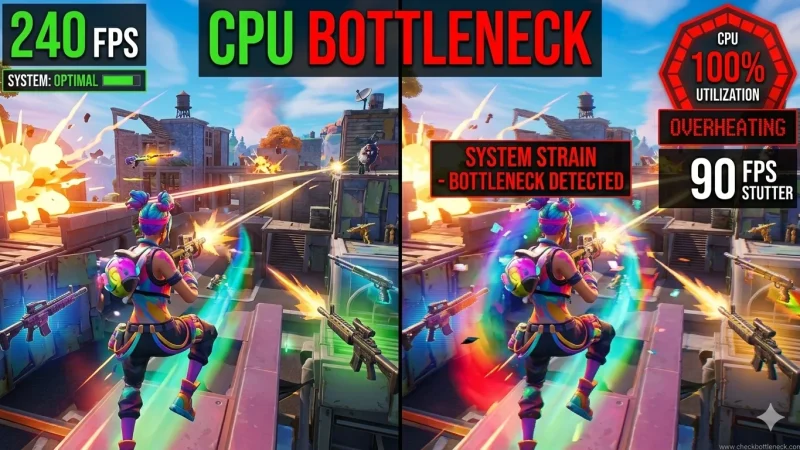
The Fortnite CPU bottleneck is the number one reason competitive players cannot reach 240 FPS consistently — and most of them blame the wrong component. At low settings in Performance Mode targeting maximum refresh rate, Fortnite is far more CPU-dependent than GPU-dependent. Upgrading your GPU from an RTX 3060 to an RTX 4080 while keeping an old CPU will deliver almost zero FPS improvement in this scenario. This guide identifies exactly when and why the Fortnite CPU bottleneck occurs and how to fix it. Use our free bottleneck calculator to see your exact bottleneck percentage.
When Fortnite Becomes CPU-Bottlenecked
At normal quality settings targeting 60 to 120 FPS, Fortnite is moderately balanced between CPU and GPU. The Fortnite CPU bottleneck becomes significant specifically when all three of the following conditions are true: you are playing at 1080p or lower, you have Performance Mode enabled, and you are targeting 144Hz or higher refresh rates. In this configuration the GPU renders frames so fast that the CPU cannot prepare game logic quickly enough for the next frame.
Minimum CPU for Fortnite
Intel Core i5-11400F or AMD Ryzen 5 5600. At this level Fortnite runs smoothly at 60 to 120 FPS at High quality settings.
Recommended CPU for Fortnite (Competitive 240Hz)
Intel Core i5-13600K or AMD Ryzen 5 7600X. These processors minimize the Fortnite CPU bottleneck at competitive settings and deliver consistent 240 FPS in most scenarios.
Best CPU for Fortnite (Esports)
Intel Core i7-14700K or AMD Ryzen 7 7800X3D. The 3D V-Cache on the 7800X3D is particularly effective in Fortnite’s game engine, delivering some of the highest consistent frame rates of any CPU available. According to Gamers Nexus Fortnite CPU benchmark, the Ryzen 7 7800X3D leads in 1% low FPS which is the metric that matters most for competitive smoothness.
Minimum GPU for Fortnite
RTX 3060 or RX 6600 XT for 1080p High quality settings targeting 60 to 120 FPS.
Recommended GPU for Fortnite (Competitive)
RTX 4070 Super or RX 7800 XT for 1080p 240Hz performance mode. Above this tier, GPU upgrades deliver diminishing returns due to the Fortnite CPU bottleneck becoming the limiting factor.
RAM for Competitive Fortnite
16GB DDR4-3200 minimum. 32GB recommended if you stream, record, or run browser and Discord simultaneously. Enable XMP in BIOS — running DDR4-2133 instead of DDR4-3600 can cost up to 15 FPS in Fortnite on Ryzen systems. Our guide on does RAM affect bottleneck explains why this matters for competitive gaming.
Free Fixes for the Fortnite CPU Bottleneck
Enable DirectX 12 mode in Fortnite’s video settings. DX12 reduces CPU overhead compared to DX11 in many configurations and can add 10–20 FPS at CPU-limited frame rates.
Disable unnecessary background applications. Browser tabs, Discord video, recording software, and antivirus real-time scanning all consume CPU cycles that compete directly with Fortnite’s game thread.
Enable XMP in BIOS and ensure dual-channel RAM. Single-channel RAM halves your memory bandwidth and creates a hidden bottleneck that stacks on top of any existing CPU-GPU gap.
Lower CPU-dependent settings specifically. Distance rendering and shadow quality are processed by the CPU in Fortnite. Lowering these specifically can reduce the Fortnite CPU bottleneck without significantly affecting visual quality.
How to Identify the Fortnite CPU Bottleneck on Your System
Open MSI Afterburner with the RivaTuner overlay while playing. If your GPU usage is consistently below 85–90% while your CPU usage is near 100%, you have a confirmed Fortnite CPU bottleneck. For a complete diagnostic guide, read our article on CPU bottleneck symptoms and should I upgrade CPU or GPU first before deciding where to spend your upgrade budget.