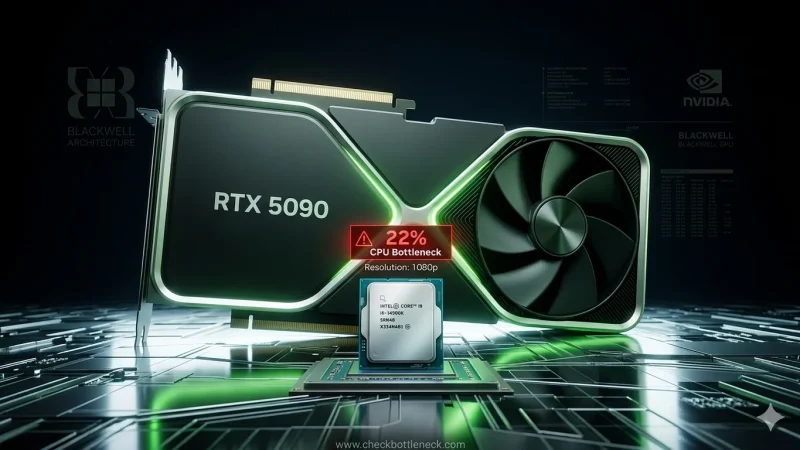
The RTX 5090 i9-14900K bottleneck reveals something remarkable about the Blackwell generation: even one of the fastest consumer CPUs ever released cannot keep up with it at 1080p. At 22% CPU bottleneck at 1080p and 14% at 1440p, the RTX 5090 is simply generating frames faster than the i9-14900K can prepare scene data for it. This page explains exactly what this means for real-world performance and what you can do about it. Check your full system with our free bottleneck calculator including RAM and storage analysis.
Bottleneck Results by Resolution
The RTX 5090 i9-14900K bottleneck at 1080p is 22%. Even with 24 cores and a 6GHz boost clock, the i9-14900K cannot fully saturate the RTX 5090 Blackwell’s rendering pipeline at low resolution.
At 1440p the RTX 5090 i9-14900K bottleneck drops to 14% — mild but still present. Most users gaming at 1440p will notice this in CPU-sensitive titles.
At 4K the bottleneck falls to just 6%. The RTX 5090 is so heavily loaded rendering 4K frames that the CPU finally has enough headroom. This is the recommended resolution for this pairing.
| Resolution | Bottleneck % | Verdict |
|---|---|---|
| 1080p | 22% | CPU Bottleneck — Noticeable |
| 1440p | 14% | Mild Bottleneck |
| 4K | 6% | Well Balanced |
CPU Score: 99,000 | GPU Score: 115,000
Why the RTX 5090 Bottlenecks Even the i9-14900K
The RTX 5090 Blackwell GPU contains 170 billion transistors and can render frames in fractions of a millisecond at resolutions below 4K. The i9-14900K, despite its impressive 24-core architecture, hits its per-frame preparation ceiling before the GPU has finished rendering. This is a fundamental limitation of CPU architectures — adding more cores does not help when the bottleneck is in sequential single-thread game engine operations that cannot be parallelized further.
According to Gamers Nexus RTX 5090 launch review, no current consumer CPU fully eliminates CPU bottlenecks with the RTX 5090 at 1080p. This is not a fault of the i9-14900K — it is simply that the GPU is ahead of where CPU technology currently sits.
For context on what CPU bottleneck symptoms look like in practice, read our guide on CPU bottleneck symptoms.
Free Fixes — Make the Most of What You Have
Game at 4K. The RTX 5090 i9-14900K bottleneck drops from 22% to 6% simply by changing resolution. This is the most impactful free change you can make.
Enable DLSS 4 with Frame Generation. DLSS 4 Multi Frame Generation on RTX 5000 series can multiply perceived frame rates without adding CPU load. This is the most effective tool for managing the RTX 5090 i9-14900K bottleneck in real-world gaming.
Make sure DDR5-6400 is running in dual-channel mode with XMP enabled. Slow RAM is a hidden additional bottleneck that stacks on top of the existing CPU-GPU gap. Read does RAM affect bottleneck for the full explanation.
Upgrade Recommendation
An Intel Core Ultra 9 285K or AMD Ryzen 9 9950X would reduce the 1080p bottleneck from 22% to approximately 10–12%. No current consumer CPU can get below 8–10% bottleneck with an RTX 5090 at 1080p. For most users, gaming at 1440p or 4K is the more practical solution than a CPU upgrade.
For guidance on prioritizing your next upgrade, read should I upgrade CPU or GPU first. For a better-balanced alternative pairing in the same tier, compare with the RTX 4080 Ryzen 7 7800X3D bottleneck.